Subterranean termite perimeter defense targets Reticulitermes colonies, which require continuous soil contact to maintain the internal moisture necessary for survival. In Salt Lake County, moisture retention along…
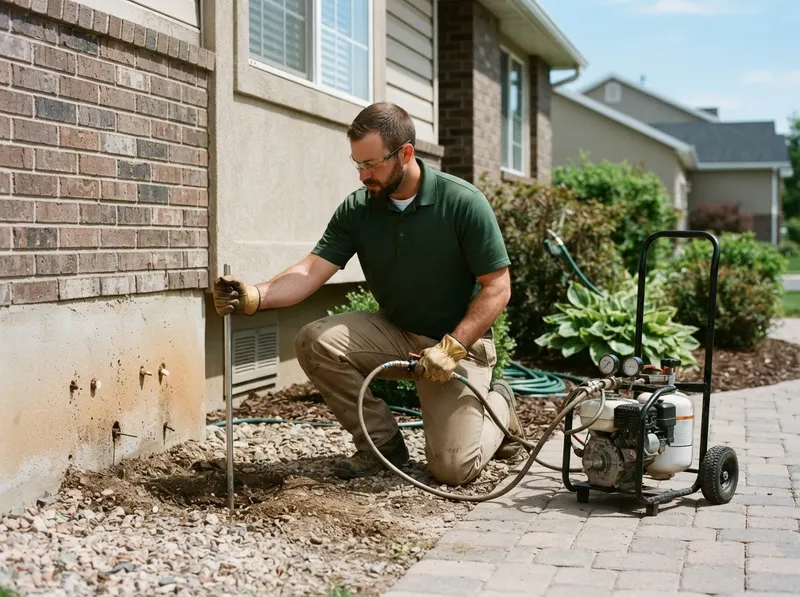
Subterranean termite perimeter defense targets Reticulitermes colonies, which require continuous soil contact to maintain the internal moisture necessary for survival. In Salt Lake County, moisture retention along foundation footings creates a viable path for workers traveling upward into sill plates and wall studs. Properties located on the older sandy loams of Rose Park and Poplar Grove or the sloping alluvial soils along East Bench and Federal Heights exhibit distinct structural settlement fissures where subterranean workers build exploratory mud tubes. Unlike localized spot-spraying that scatters workers deeper into wall voids, an uninterrupted non-repellent liquid application allows foraging termites to pass through the treated zone, transfer the active material back to the subterranean nest, and neutralize the reproductive core without alarming the colony.
Selecting a continuous perimeter chemical barrier suits structures with exposed foundation footings, accessible unfinished basements, and unencumbered perimeter soil. For homes in The Avenues, Sugar House, or Liberty Wells that feature abutting historic brick, stone porches, or wrap-around concrete patios, our team combines sub-slab pressure injection through four-inch concrete drill ports with exterior in-ground subterranean bait matrices. The operational trade-off centers on initial physical impact versus continuous barrier longevity: liquid perimeter trenches provide immediate lethal exclusion zones lasting up to 8 years, whereas exterior bait station networks require zero structural drilling but demand bi-annual cartridge monitoring to intercept worker populations migrating from adjacent irrigation corridors near Liberty Park or the Jordan River.
Subterranean termite perimeter defense differs fundamentally from drywood termite procedures; subterranean treatments strictly address ground contact points rather than whole-structure thermal or gas enclosures. Standard retail surface sprays purchased at local hardware suppliers fail because subterranean termites do not travel across exposed interior baseboards, utilizing enclosed cellulose-lined mud tunnels instead. Installing perimeter defense follows three sequential steps: first, technicians dig a continuous 6-inch by 6-inch trench directly against exposed exterior stem walls; second, liquid termiticide is injected at 4 gallons per 10 linear feet down to the top of the footing; third, backfill soil is blended with termiticide to seal vertical migration avenues against the concrete.
Every job gets a firm, written price after a free on-site visit.
Tell us about your subterranean termite perimeter defense job in Salt Lake City and we'll send a clear, written quote, usually the same day.
 Pestiva Response Solutions