Excess subterranean humidity in Salt Lake County creates a destructive biological bridge between damp soil and structural framing. In older residential properties throughout Sugar House, Liberty Wells, and The Avenues,…
Excess subterranean humidity in Salt Lake County creates a destructive biological bridge between damp soil and structural framing. In older residential properties throughout Sugar House, Liberty Wells, and The Avenues, sandstone and unreinforced concrete foundations draw moisture directly from the earth through capillary action. This persistent dampness pushes relative humidity levels past 70 percent beneath living spaces. Wood-decay fungi colonize subfloor joists while microclimates attract destructive pests. Subterranean termites require this damp environment to maintain their moisture-dependent mud tubes, while Norway rats and house mice actively seek damp crawl spaces to nest beneath fiberglass batts, chewing through wiring and contaminating thermal insulation with droppings.
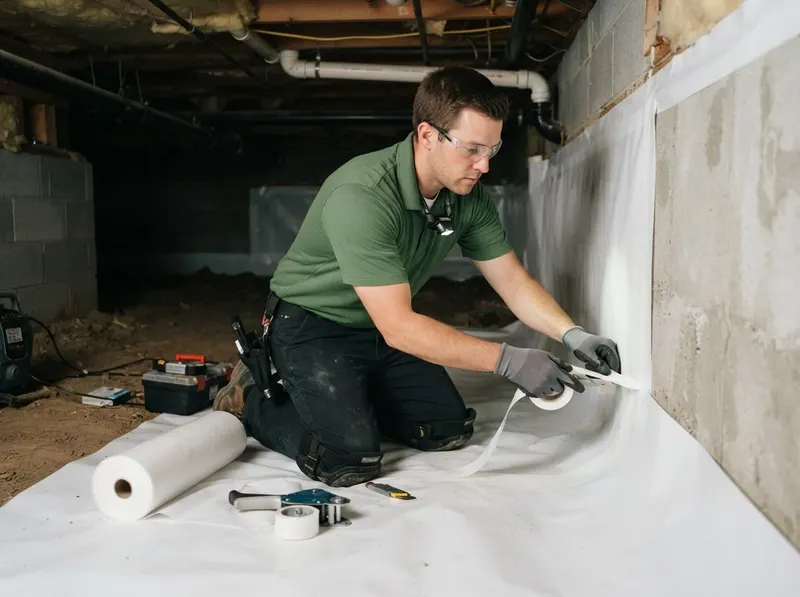
Crawl space encapsulation moisture remediation resolves these structural threats by decoupling the subfloor environment from external ground moisture and outdoor air. If a home exhibits isolated foundation-wall sweating without standing water, a targeted 12-mil barrier upgrade with mechanical vent sealing is often sufficient. If the crawl space suffers from persistent seasonal seepage along the East Bench or high water tables near Poplar Grove and Rose Park, full encapsulation featuring a 20-mil cross-laminated barrier, continuous wall-to-sill tape bonding, and an energy-rated crawl space dehumidifier is required. The trade-off is mechanical dependency: a fully encapsulated, sealed system requires routine annual checks of the relative humidity monitor and dehumidifier drainage line, whereas open venting permits continuous external humidity and pest intrusion.
Pestiva Response Solutions executes crawl space moisture remediation using a sequence of objective environmental controls. 1. Technicians measure joist wood moisture equivalent (WME) percentages and subfloor ambient humidity across four perimeter points. 2. Field personnel clear soil debris, old cellulose waste, and rodent-soiled insulation from the earth bed. 3. Crews seal foundation vents and exterior penetrations using closed-cell polyurethane expanding foam. 4. Technicians lay puncture-resistant vapor retarders across 100 percent of exposed soil, overlapping seams by a minimum of 12 inches and fastening the membrane up foundation piers. 5. If relative humidity exceeds 60 percent post-sealing, an automated condensate dehumidifier is mounted to maintain equilibrium throughout Salt Lake City freeze-thaw cycles.
Every job gets a firm, written price after a free on-site visit.
Tell us about your crawl space encapsulation moisture remediation job in Salt Lake City and we'll send a clear, written quote, usually the same day.
 Pestiva Response Solutions